Saturday, December 14, 2013

A wealth of information, shaping our world.


                My blog has focused on the most prevalent concerns for the internet thus far, but little on what makes the internet great. I would like to look into the reasons why these concerns are such a big deal, and it is entirely because the internet is a big deal.
                The internet has connected the world. A fair and uncensored internet allows anyone to view anything anyone else made, from anywhere. This means that opinions from around the world are heard everywhere. This is especially helpful in the case of perspective of those from other countries. Since we can interact with, watch videos of, etc. of other people, we realize how similar everyone in the human race is. The internet is unintentionally fighting things like racial prejudices because of this, and also empowering anyone to feel that they have a voice.

                There are several potential obstructions to these amazing powers that the internet presents to us. The issues of censorship and lack of fairness can remind us of how “for hundreds of years, courts and governments have struggled over the duties that carriers like ferries, railroads, or telephone companies owe to the public by virtue of their necessity to economic and social welfare.” (Lee, 61) This can give us inspiration that, so long as we continue to weigh out all of the potential issues of the ways we manage the internet, we will continue to provide as great a social value with the internet as possible. For this to happen however, we need to have our voices heard loudly when the controlling factors such as governments and ISP’s want to change the way the internet works, to tell them that we want to ensure that the power of the internet only increases and is never degraded by biases or greed.

Sources:
Lessig, Lawrence. "The Internet under Siege." Foreign Policy 127 (2001): 55-65. Print.
Cheng, Hsing K., Subhajyoti Bandyopadhyay, and Hong Guo. "The Debate on Net Neutrality: A Policy Perspective." Information Systems Research 22.1 (2011): 60-82. Print.
"Network Neutrality." Wikipedia. Wikimedia Foundation, 27 Nov. 2013. Web. 16 Dec. 2013.

"Net Neutrality: A Solution in Search of a Problem." National Taxpayers Union -. National Taxpayers Union, Web. 16 Dec. 2013..


Friday, December 13, 2013

ISP's are companies. Why should they care?


                My previous posts discussed some of the important goals that the internet was founded on: being a place to view the world’s information without restriction. In this post I would like to discuss another extremely important goal that the internet set to achieve, and that is fairness.
                In the internet’s initial implementation, one of the founding ideas was that every packet of data was treated as such. There weren't high priority packets, or packets you could just drop because you felt like that, there were just packets. All packets would be treated equally. Reflecting on the internet’s progress today shows us a bustling network of innovation and resiliency. Much of that success is to be credited to the goals adhered to since the beginning of the internet for fairness, right?
This is a topic that is heavily debated today, especially after Internet Service Providers have started experimenting with the pre-existing rules of the internet to see how far they could get. “On October 19, 2007, for instance, the Associated Press (AP) reported that Comcast, the United States' largest cable TV operator and second largest Internet provider, had interfered with users' access to file-sharing sites such as BitTorrent.” (Choi, 447) In this circumstance, Comcast blocked users from accessing BitTorrent once they reached a certain threshold of usage for the month, since this traffic was overwhelming their network’s other normal-use traffic. Not only does this appear to be a valid concern and means of solving the problem, it is also backed with the fact that the majority of BitTorrent usage is to distribute copyrighted material illegally. For this reason, torrent throttling is generally an accepted behavior for ISP's.

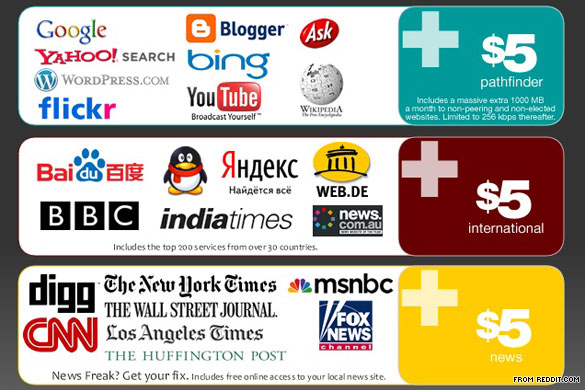
             Once ISP's made one step in the direction of treating some packets differently, they saw how far they could go. As a business distributing content, like TV networks, they decided that they should be able to gain priority services which had reserved resources to ensure that they always ran smoothly and quickly. This high-priority internet fast-lane resembles the way that TV networks have content that makes the most money on the channel more frequently, rather than allocating all time slots evenly among any potential content. ISP's could promote their own content over others’, as well as charge to have a content provider’s data travel faster and with high priority to their users. Something to realize about this approach is that “networks are complex systems, tying up network elements in one part of the network can have an adverse impact on portions of the network located far from the element being accessed.” (Spulber, 1904) As a result of this, all other traffic would be splitting a smaller portion of the entire ISP's network resources, and slow down. Also, relating back to the TV analogy, “such a payment structure would result in the Internet increasingly resembling today’s mass media, where a few Internet service providers (ISP's) control what the customers effectively may access.” (Cheng, 1) Eventually one could imagine that only content providers with the money to pay the ISP could get their content on the internet.
                One of the greatest aspects of the internet is its competitive potential between any content providers, due to the fairness of the internet itself. Any startup, even with limited resources, can challenge the heavyweight competitor in its field, since they both have the same distribution platform. This is arguably the reason why new innovations arise from the internet so quickly, as new content providers continually challenge old ones to innovate to stay relevant and ahead of the others.

Sources:
Spulber, Daniel F., and Christopher S. Yoo. "Mandating Access to Telecom and the Internet: The Hidden Side of Trinko." Columbia Law Review 107.8 (2007): 1822-907. Print.
Choi, Jay Pil, and Byung-Cheol Kim. "Net Neutrality and Investment Incentives." The RAND Journal of Economics 41.3 (2010): 446-71. Print.
Guo, Hong, Subhajyoti Bandyopadhyay,, Hsing K. Cheng, and YuChen Yang. "Net Neutrality and Vertical Integration of Content and Broadband Services." Journal of Management Information Systems 27.2 (2010): 243-75. Print.

What's a country to do?


                I previously wrote a post about the dangers of internet censorship from the consumer’s perspective. Though most cases of such censorship that are written about are those of oppressive, authoritative governments controlling their people without their knowledge, these aren't the only cases.
                Many times, governments use censorship to censor illegal or offensive activity. For example, “German courts have imposed strict liability on ISP's for hosting copyright infringement, one German jurisdiction has sought to require ISP's to block access to extraterritorial neo-Nazi websites, and another has barred news sites from carrying links to the home page of a company that may provide circumvention technology.” (Kreimer, 20) Due to its illegal nature, censoring copyright infringing locations on the internet is a well-justified means of enforcing the law. By blocking neo-Nazi websites, Germany falls into the sometimes dangerous territory of enforcing their idea of “correct” views on others. In this case however, by blocking a hate group’s content, it shows the potential of censoring in this way for good. Finally, the circumvention technology is an interesting case to consider. Since there are means of circumventing local censorship, they need to be stopped for censorship to be effective. This circumvention typically works with proxy servers that request web pages as if they were being sent to another country, then sending an encrypted copy to the requester. Though stopping proxy servers can be effective at enforcing a censorship, it is also stopping all the potential legitimate uses of the proxy servers, so this isn't an ideal solution.

                In other situations, governments take control of the internet for what they believe to be the well-being of the people. For example, when rebels started using Twitter to organize riots and even give missile orders, the Syrian government shut down all access to Twitter itself. Though social media blocks are sometimes considered an immediate emergency measure, countries like Iran have had many-year blocks on social media due to fear of rebellious uprisings.
An interesting final case to consider is that of China’s search engines. The search engines in China are subject to very specific censorships with no exceptions. For this reason, most of the search engines in China are local to China. Google, which is in the business of making money off searches, eventually caved from their original goal of remaining entirely uncensored and decided to provide China with a censored version of their own search engine, just so China would allow them to deploy their search engine there. Google believed that, though censorship is bad, their services could still improve the lives of those in China while censored in some regards. This prompted the “’Global Online Freedom Act,’ purporting to bar American Internet intermediaries- including search engines and blog hosts - from complying with demands by ‘Internet-restricting countries.’” (Kreimer, 19) Acts, such as this one, have proven so far to be just a cry for attention in the ongoing battle on regulation of internet censorship.
Hopefully, these examples have exposed that not all cases of internet censorship are clear-cut and bad. At the same time, it exposes the murky waters of internet censorship in the case where a government thinks it is protecting people, when that opinion is subjective.

Sources:

Kreimer, Seth F. "Censorship by Proxy: The First Amendment, Internet Intermediaries, and the Problem of the Weakest Link." University of Pennsylvania Law Review 155.1 (2006): 11-101. Print.

What censorship?


Censorship is not always a bad thing. Most people are exposed to censorship for the first time when they watch TV as a child. Curse words are bleeped out, and nudity is blurred. This content is censored because it is generally considered to be inappropriate for young viewers. The key here is the general agreement on appropriateness in this circumstance. Since the majority agree, those who oppose this censorship generally understand that they are a minority and that the issue isn't that important. They might result in being slightly annoyed that they can’t hear all the cursing without the annoying bleeps, but they leave it at that.
                The previous example represents censorship that isn't a big issue to most people, and is clearly apparent. When censorship is a big issue, people tend not to sit idly by and accept that their content has been altered based on some group’s bias for what they are consuming. When Fox News and another news group report the same story, each leaving out specific details to portray an apparent view, the public voices their concern. News agencies get called out frequently for having biases like these, and they are confirmed by the availability of other news reporting the same stories. The other possible combination of censorship not being a big issue, but also not very apparent isn't very important, so I won’t go into much detail here.

                What I will describe next, Internet censorship, is one of the most terrifying uses of censorship possible. To understand internet censorship, you must first understand the internet itself. The internet is a series of links, each transmitting a packet of data from a content provider to a consumer (in the cases I’d like to consider here). At the end of each link lives a piece of networking hardware, owned by a local internet company, or a larger internet service provider. Any person in control of the hardware at that link can monitor everything going in and out of it, and even alter the information passing through it.
                Now imagine a scenario where a government, or any other group with control over any of the links on your path, decides they would like to enforce their own agenda on information being passed through. This brings forward a type of censorship that is known to exist, but those who are looking at censored content are likely unaware. In the case where your country is playing propaganda over loudspeakers, it may not be too difficult to realize there might be a bias in the information you are receiving. On the other hand, consider an internet user who believes that they are looking at all of the possible sources of information about current events, when outsiders know that those in their country are unaware of the fact that they are blocked from all but sources that conform to their government’s agenda. This can be used at the whim of the government in any circumstance. For example, Pakistan’s Supreme Court enforced that those controlling internet links in the country must block cartoons caricaturing the Prophet Muhammad, because they didn’t want their people’s opinions to be altered by them. Even more extreme are the uses if internet censorship in China. Those who researched such censorship concluded that the Chinese government ‘has been obsessed with ensuring that its people have access to “correct” information that supports the state’s propaganda.’ (Chung, 731)
                This all begs the question: Is what you read on the internet exposing you to a world of information, or a subset of information that someone wants you to see? Is there any way for you to know?

Sources:
Kreimer, Seth F. "Censorship by Proxy: The First Amendment, Internet Intermediaries, and the Problem of the Weakest Link." University of Pennsylvania Law Review 155.1 (2006): 11-101. Print.

Chung, Jongpil. "Comparing Online Activities in China and South Korea: The Internet and the Political Regime." Asian Survey 48.5 (2008): 727-51. Print.