
Censorship is not
always a bad thing. Most people are exposed to censorship for the first time
when they watch TV as a child. Curse words are bleeped out, and nudity is
blurred. This content is censored because it is generally considered to be
inappropriate for young viewers. The key here is the general agreement on
appropriateness in this circumstance. Since the majority agree, those who
oppose this censorship generally understand that they are a minority and that
the issue isn't that important. They might result in being slightly annoyed
that they can’t hear all the cursing without the annoying bleeps, but they
leave it at that.
The
previous example represents censorship that isn't a big issue to most people,
and is clearly apparent. When censorship is a big issue, people tend not to sit
idly by and accept that their content has been altered based on some group’s
bias for what they are consuming. When Fox News and another news group report
the same story, each leaving out specific details to portray an apparent view,
the public voices their concern. News agencies get called out frequently for
having biases like these, and they are confirmed by the availability of other news
reporting the same stories. The other possible combination of censorship not
being a big issue, but also not very apparent isn't very important, so I won’t
go into much detail here.
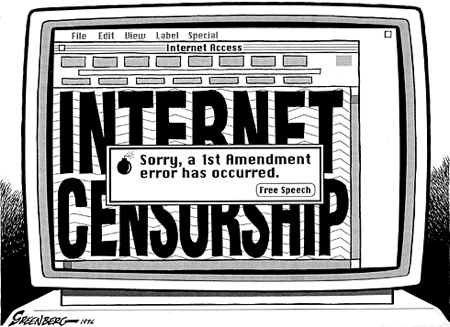
What
I will describe next, Internet censorship, is one of the most terrifying uses
of censorship possible. To understand internet censorship, you must first
understand the internet itself. The internet is a series of links, each
transmitting a packet of data from a content provider to a consumer (in the
cases I’d like to consider here). At the end of each link lives a piece of
networking hardware, owned by a local internet company, or a larger internet
service provider. Any person in control of the hardware at that link can
monitor everything going in and out of it, and even alter the information
passing through it.
Now
imagine a scenario where a government, or any other group with control over any
of the links on your path, decides they would like to enforce their own agenda
on information being passed through. This brings forward a type of censorship
that is known to exist, but those who are looking at censored content are
likely unaware. In the case where your country is playing propaganda over
loudspeakers, it may not be too difficult to realize there might be a bias in
the information you are receiving. On the other hand, consider an internet user
who believes that they are looking at all of the possible sources of
information about current events, when outsiders know that those in their
country are unaware of the fact that they are blocked from all but sources that
conform to their government’s agenda. This can be used at the whim of the
government in any circumstance. For example, Pakistan’s Supreme Court enforced
that those controlling internet links in the country must block cartoons
caricaturing the Prophet Muhammad, because they didn’t want their people’s
opinions to be altered by them. Even more extreme are the uses if internet
censorship in China. Those who researched such censorship concluded that the
Chinese government ‘has been obsessed with ensuring that its people have access
to “correct” information that supports the state’s propaganda.’ (Chung, 731)
This
all begs the question: Is what you read on the internet exposing you to a world
of information, or a subset of information that someone wants you to see? Is
there any way for you to know?
Sources:
Kreimer,
Seth F. "Censorship by Proxy: The First Amendment, Internet
Intermediaries, and the Problem of the Weakest Link." University of
Pennsylvania Law Review 155.1 (2006): 11-101. Print.
Chung,
Jongpil. "Comparing Online Activities in China and South Korea: The
Internet and the Political Regime." Asian Survey 48.5 (2008):
727-51. Print.

No comments:
Post a Comment